
Designing Energy Systems for Expansion Under Acceleration: A Different Kind of Growth Problem
The energy system is expanding rapidly and unevenly. Load is being added faster than many of the structures designed to absorb it can respond. Large customers are moving on compressed timelines. Customer-side resources are scaling opportunistically. Technology cycles are shortening. None of this is inherently problematic. What’s challenging is how misaligned the system becomes when growth accelerates without coordination.
This moment is less about replacing one system with another and more about designing for expansion under acceleration.
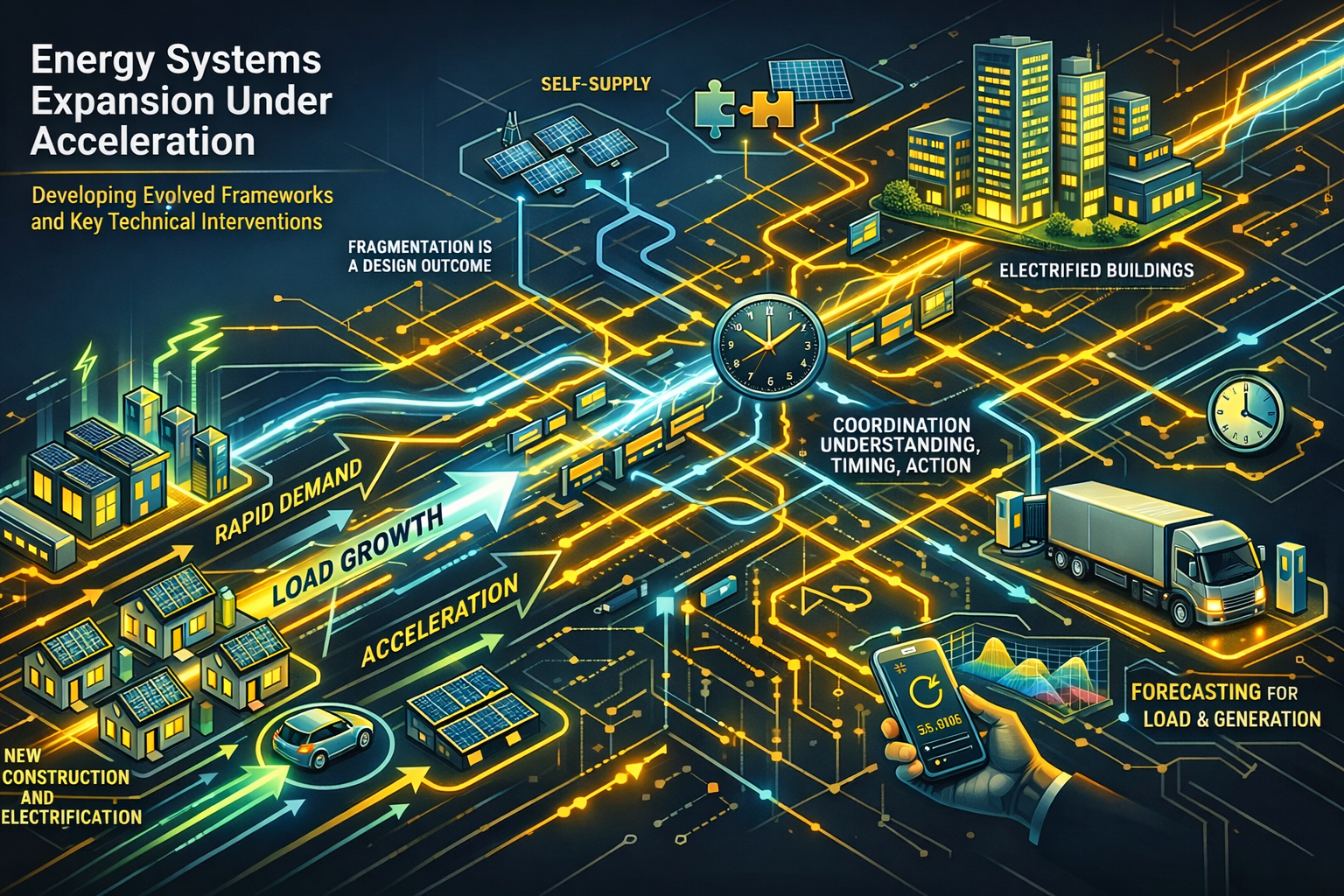
When Timing Becomes the Constraint
One of the most important signals emerging right now is not just how much demand is growing, but how it behaves.
Large loads are no longer willing to wait for traditional planning and interconnection timelines. When the system cannot move at the pace required, customers adapt. Self-supply, parallel development paths, and alternative solutions emerge. These responses are rational. They reflect a mismatch between how quickly demand now shows up and how slowly the system was designed to respond.
In this environment, timing becomes a first-order constraint. Not technology. Not cost. Not even policy. The ability of the system to respond in time increasingly determines whether customers stay within it or build around it.
Fragmentation Is a Design Outcome, not a Failure
Electrification, load growth, and customer-side resources are often discussed as system-level phenomena. In practice, they are still governed and executed through fragmented structures.
Planning, interconnection, procurement, customer programs, and market participation each operate with their own objectives, timelines, and success metrics. Individually, these functions are thoughtful and well designed. Collectively, they struggle to move together.
This is not because people are failing. It’s because the system was never designed for this level of coordination under speed. Decisions made in one lane quietly constrain options in another. Assumptions do not always travel across functions. By the time tensions surface, the system has already adapted around them.
Fragmentation, in this sense, is not a bug. It is an outcome of how responsibilities, incentives, and timelines are structured.
Workarounds as System Signals
When coordination breaks down, workaround behavior emerges.
Self-supply. Parallel development. Local optimizations that solve immediate needs while introducing complexity elsewhere. These responses are often framed as threats or edge cases. But they are better understood as signals.
They tell us where timing mismatches exist. They reveal where coordination is missing. They highlight where the system is asking participants to choose between waiting and acting.
Seen this way, workaround behavior is not evidence that the system is being bypassed out of preference. It is evidence that the system is not always available when it is needed.
Coordination Under Acceleration
The hardest problems facing the energy system today are not primarily technological. They are organizational and temporal.
Coordination across planning, operations, markets, and customer experience becomes exponentially more difficult when growth accelerates. Yet coordination is often treated as an overlay rather than as core infrastructure.
Designing for expansion under acceleration requires treating alignment as a system feature. It means asking not just whether individual components work, but whether they arrive together, at the right moment, with shared assumptions about risk, cost, and responsibility.
This is a different design challenge than the one the industry has spent decades solving. It demands new ways of thinking about sequencing, governance, and decision-making across institutional boundaries.
Closing Reflection: A Design Question, not a Verdict
This moment does not call for blame or simple prescriptions. It calls for clarity about the nature of the problem.
We are not only transitioning the energy system. We are expanding it rapidly, under conditions of acceleration. That reality changes what matters most in system design.
The question ahead is not whether individual components perform as intended. It is whether the system they form can align understanding, timing, and action quickly enough to remain relevant to the demands being placed on it. That feels like the design challenge of this phase.
